
How Retailers Use Vendor Compliance Programs to Protect Margins
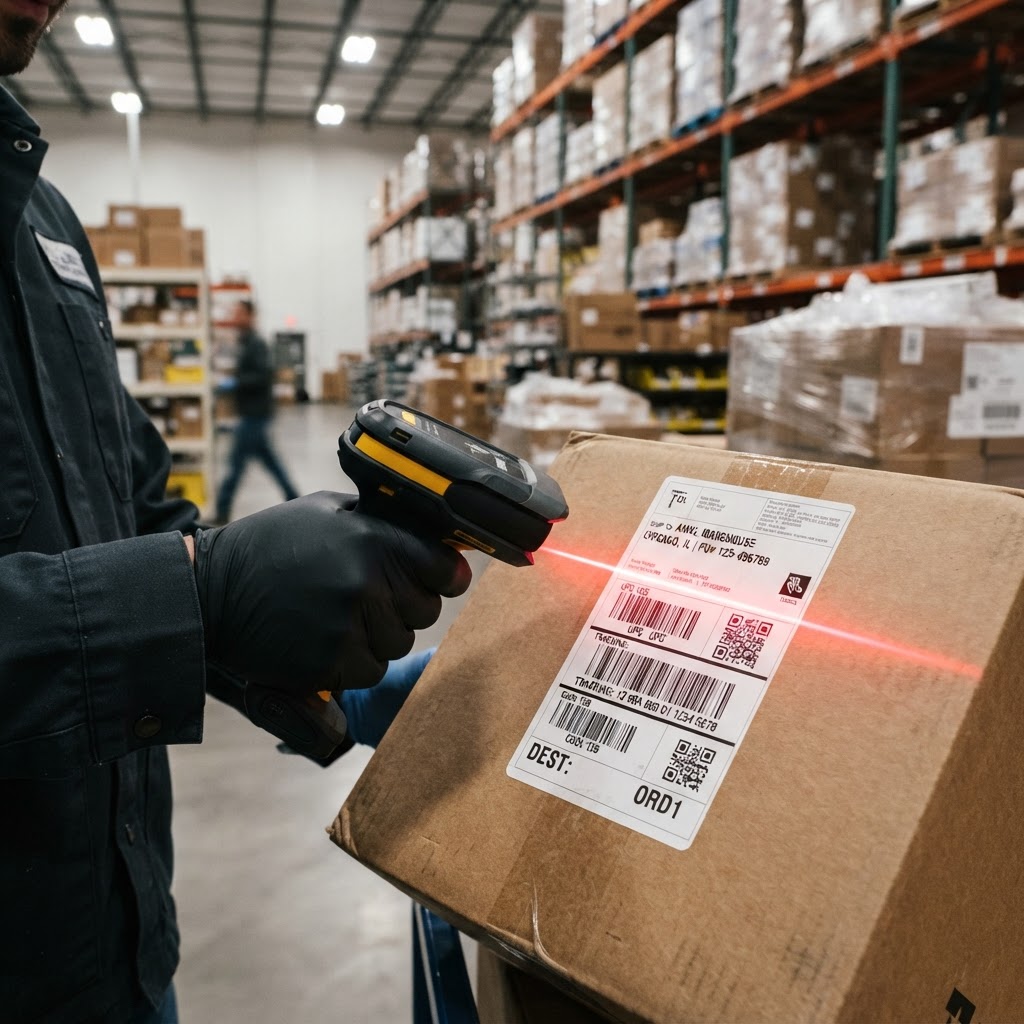
A retailer’s distribution center is engineered around a simple assumption: every inbound shipment arrives with a matching electronic manifest already loaded into the warehouse management system. When that assumption holds, a truck pulls up to the dock, cartons come off, a scanner reads each carton’s SSCC-18 barcode, the system matches it to the Advance Ship Notice (ASN) data, and the conveyor routes it automatically to the right staging lane for store-bound trucks or cross-dock transfer. No one opens a carton. No one counts anything by hand. The product moves from dock to outbound trailer in minutes.
When that assumption breaks — a missing or late ASN, a carton with a wrong or missing barcode, a quantity mismatch between what the ASN says and what’s physically on the pallet — the entire automated flow stops for that shipment. And that’s where the cost argument for vendor compliance programs actually lives. It’s not an abstract theory about efficiency; it’s a concrete operational disruption with a concrete labor cost, and chargebacks are how the retailer recovers it.
What the DC Actually Does Differently: Compliant vs. Non-Compliant
To see why chargebacks exist, it helps to trace the same shipment through both paths — compliant and non-compliant — and count the difference.
A compliant shipment: Your ASN arrives in the retailer’s system before the truck does. When the trailer opens at the dock, a dock worker scans the first carton’s SSCC-18 label. The system finds it in the pre-loaded ASN data, confirms the carton belongs to PO 850-44719, and the conveyor carries it away. The worker scans the next carton — same flow. An entire pallet of 48 cartons is processed in under a minute, because the system already knows what each carton contains, which store it’s destined for, and which outbound truck it needs to be cross-docked onto. The worker’s job is scanning and confirming, not inspecting. The shipment flows through the DC’s automated pipeline like it was designed to.
A non-compliant shipment: The ASN is missing, late, or the carton barcodes don’t match the ASN data. The truck arrives, the dock worker scans the first carton, and the system returns no match — or worse, a mismatch error. The conveyor can’t route what it can’t identify. The shipment gets pulled off the automated line and moved to a manual receiving staging area. Now a different set of workers has to handle it: someone opens cartons, counts the actual contents, and records what’s physically there. Someone else tries to reconcile the physical count against the purchase order (if the ASN never arrived, the PO is the only reference point). Someone determines which store the product was meant for — information that should have been embedded in the ASN’s carton-level pack structure but now has to be reconstructed from the PO or from routing guide defaults. The product can’t cross-dock to an outbound truck because no one knows which store lane it belongs in. It sits in the manual staging area until the reconciliation is complete, which delays the product reaching the store shelf.
Count the difference: the compliant shipment consumed one worker’s time for about a minute of scanning. The non-compliant shipment consumed multiple workers across receiving, reconciliation, and problem-resolution, occupied manual staging space, delayed the product’s path to the shelf, and may have missed an outbound truck’s departure window — which means the product sits an extra day in the DC, or the store doesn’t get its replenishment in time for a promotional set. That’s real labor cost, real lost sales from delayed shelf availability, and real disruption to a DC that was designed to process thousands of cartons per hour through automation, not hand-reconcile exceptions.
The chargeback isn’t a penalty for breaking a rule. It’s the retailer saying: you broke our automated receiving flow, this is what it cost us to fix your shipment by hand, and we’re recovering that cost from your invoice. Vendor compliance programs formalize that cost recovery so it’s consistent, documented, and applied across the supplier base — not arbitrary.
Why the Programs Exist at Scale
A single non-compliant shipment is a manageable exception. The problem is volume. A major retailer’s DC processes thousands of inbound shipments per week. If even 5% of those shipments break the automated receiving flow, that’s hundreds of shipments per week requiring manual intervention — each one consuming labor, staging space, and time that the DC’s automated infrastructure was built to eliminate. At scale, non-compliance isn’t a rounding error; it’s a sustained operational drag that directly erodes the margin the retailer earns on the products they sell.
This is why compliance programs aren’t just about recovering individual shipment costs. A retailer with 10,000 vendors can’t afford to have a significant percentage of them shipping inconsistently — the aggregate manual processing load would overwhelm the DC’s exception-handling capacity. The chargeback structure creates a financial incentive that pushes compliance back to the source: the supplier who controls whether the ASN is sent on time, whether the barcodes are correct, and whether the carton structure matches the electronic manifest. The program exists to prevent the cost from being incurred in the first place, and to recover it consistently when it is.
What Makes a "Preferred Vendor"
Retailers track supplier compliance scores, and those scores influence operational decisions that go beyond chargeback recovery. Suppliers with consistently high compliance scores — meaning their shipments flow through automated receiving without interruption — become vendors the retailer can rely on. That reliability translates into better shelf placement decisions, earlier access to promotional programs, more purchase orders (because the retailer’s purchasing systems favor vendors whose product actually arrives on shelf on time), faster payment terms, and priority in line reviews. The compliance score isn’t just a defensive metric you keep above threshold to avoid chargebacks; it’s an active signal the retailer uses to decide where to allocate purchase orders and merchandising opportunities.
The Supplier’s Side of the Equation
Understanding the DC-efficiency rationale changes how you should think about compliance. If you view chargebacks as arbitrary fines to be minimized or disputed, you’ll treat compliance as a cost center — something to manage reactively. If you understand that each chargeback represents a real disruption the retailer had to pay someone to fix, you’ll treat compliance as an operational discipline that prevents the disruption from occurring.
The suppliers who become preferred vendors aren’t the ones who dispute chargebacks most effectively. They’re the ones whose shipments never trigger the manual receiving flow in the first place — whose ASNs arrive on time with correct carton-level structure, whose barcodes scan on the first read, whose quantities match exactly. That level of consistency requires infrastructure: an EDI process that transmits documents automatically at the right time, labeling that’s generated from the same data source as the ASN, and validation that catches discrepancies before the truck leaves your dock. The compliance program rewards suppliers who have that infrastructure and penalizes those who don’t — which is exactly the incentive structure the retailer designed.
Need Help with EDI Compliance?
Our team has been helping suppliers navigate retailer requirements since 2002. Whether you're onboarding with a new retailer, fighting chargebacks, or looking to automate your EDI process — we can help.
Spring Systems EDI Team
EDI & Retail Compliance Experts Since 2002
Related Articles


Have Questions About EDI?
Our team is available by phone and email to help with any compliance challenge.